
For a modern jewellery buyer, especially one drawn to individuality and subtle expression, opals hold a unique appeal. But beyond their beauty lies an equally fascinating story, one that begins deep within the earth and ends as a refined piece of jewellery. Understanding how opals are created, discovered, and crafted adds a deeper layer of appreciation to every piece you wear. It transforms a purchase into something more meaningful, more personal.
The Natural Formation of Opals: A Slow Work of Art
Unlike gemstones such as diamonds or rubies, which are shaped under intense geological conditions, opals emerge through a gentler, time-driven process. They develop as layers of silica carried by water, slowly settle, and solidify over millions of years. It begins when rainwater seeps deep into the ground, carrying dissolved silica from sandstone. Over time, this silica-rich solution settles into cracks and cavities in rocks. As the water evaporates, it leaves behind tiny silica spheres. These spheres stack together in a precise, grid-like pattern.
This structure is what creates the iconic “play-of-colour” effect. When light hits these spheres, it diffracts, producing flashes of blues, greens, reds, and yellows. No two opals form in exactly the same way, which means every stone is inherently one-of-a-kind. For buyers, this uniqueness is what makes opal jewellery feel personal. It is not just designed, it is discovered.
Where Are Opals Found: A Global Treasure
While opals are found in several parts of the world, Australia remains the most significant source, producing over 90% of the world’s precious opals. Other notable locations include Ethiopia, Mexico, and Brazil.
Each region produces opals with slightly different characteristics. Australian opals are known for their stability and vivid colour play, while Ethiopian opals often have a translucent, almost ethereal appearance. Experts recommend that when choosing opal jewellery, always consider the origin and stability of the stone. For everyday wear, opt for well-treated and stable opals, like those curated by trusted brands to ensure longevity without compromising on beauty.
The Journey of Opal from Earth to Jewellery
Every opal carries a story that begins deep within the earth and unfolds through careful craftsmanship. From its natural formation to its final setting, each step shapes the stone into a piece of jewellery meant to be worn and remembered.
Extraction: Bringing Opals to Light
Unlike diamonds, opals are relatively soft and require careful extraction. Mining is often done through open-cut methods or underground shafts, depending on the location. Miners carefully remove layers of rock to reveal opal seams, which can appear as thin veins or larger nodules. Because opals are delicate, excessive force can damage them. This makes the extraction process both labour-intensive and skill-driven. The rarity of high-quality opals, combined with the precision required to extract them, adds to their value. It also explains why well-crafted opal jewellery is considered both artistic and collectible.
Cutting and Polishing: Revealing the Inner Fire
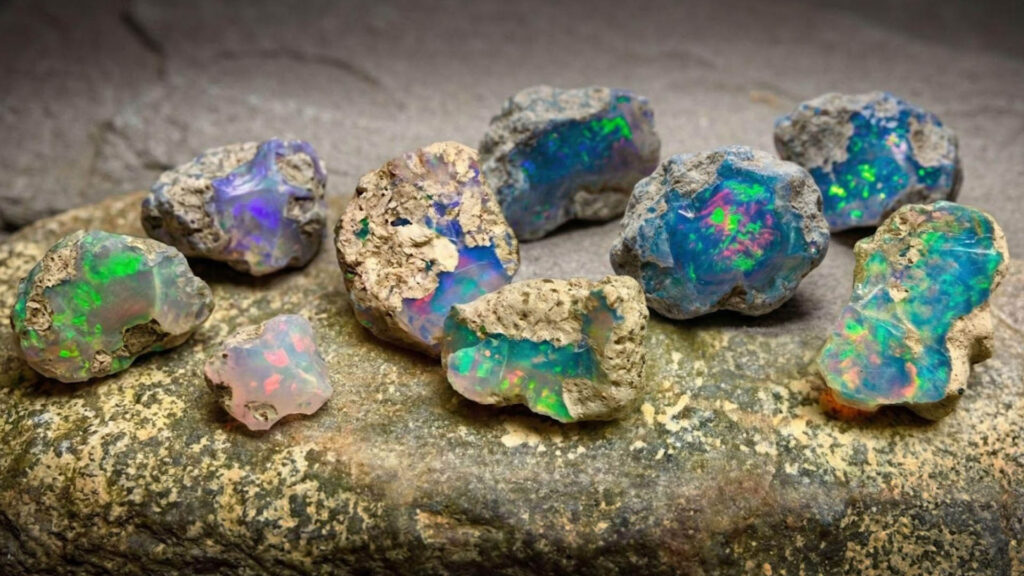
Once extracted, raw opals look far from the luminous stones seen in jewellery stores. They often appear dull or rough, with their true colours hidden beneath the surface. The cutting process is where craftsmanship begins to shine. Skilled lapidaries study each stone carefully to determine the best way to reveal its colour patterns. Unlike faceted gemstones, opals are typically cut into smooth, rounded shapes known as cabochons. This enhances their play-of-colour and gives them a soft, glowing finish. Polishing further refines the surface, allowing light to interact seamlessly with the silica structure.
Enhancements and Upgrades: Making Opals Wearable
Natural opals can sometimes be fragile or porous, which makes them less suitable for daily wear in their raw form. This is where modern techniques play a role in enhancing their durability. Common methods include stabilisation, where the stone is treated to reduce moisture sensitivity, and the creation of doublets or triplets. These involve layering opal with backing materials to improve strength and visual appeal. For buyers, this is not about altering authenticity, but about making opals more practical for contemporary lifestyles.
If you are investing in opal jewellery for regular use, prioritise pieces that are professionally treated and set securely. Popular brands focus on designs that balance delicacy with durability, making them suitable for both workdays and special occasions.
From Stone to Style: The Jewellery Perspective
Brands today understand the modern wearer. Opals are not just positioned as statement pieces but as everyday expressions of individuality. Designs often feature minimal settings, allowing the opal to remain the focal point. Whether it is a pair of understated earrings, a sleek pendant, or a contemporary ring, the emphasis is on versatility.
The brand’s approach aligns with a broader shift in jewellery preferences. Buyers today are looking for pieces that are meaningful yet wearable, distinctive yet subtle. Opals fit seamlessly into this narrative.
Why Do Opals Matter to Today’s Buyer
In a market filled with predictable brilliance, opals offer something refreshingly different. Their beauty is not uniform, and that is precisely their strength. For a buyer, choosing an opal piece is less about following trends and more about embracing individuality. It is about wearing something that evolves with light, mood, and perspective.
And when you understand the journey of an opal, from its formation beneath the earth to its transformation into a finished piece, it becomes more than jewellery. It becomes a story you carry with you.
From Formation to Forever: The Enduring Story of Opal Jewellery
Opals represent a rare intersection of nature and craftsmanship. They are formed over time, shaped with care, and designed to resonate with the modern wearer. Popular jewellery brands bring this journey full circle by translating the raw beauty of opals into refined, wearable pieces. For buyers, this means investing in jewellery that is not only visually striking but also rooted in authenticity and expertise. In the end, an opal is not just chosen for how it looks, but for how it feels. And that is what makes it timeless.