
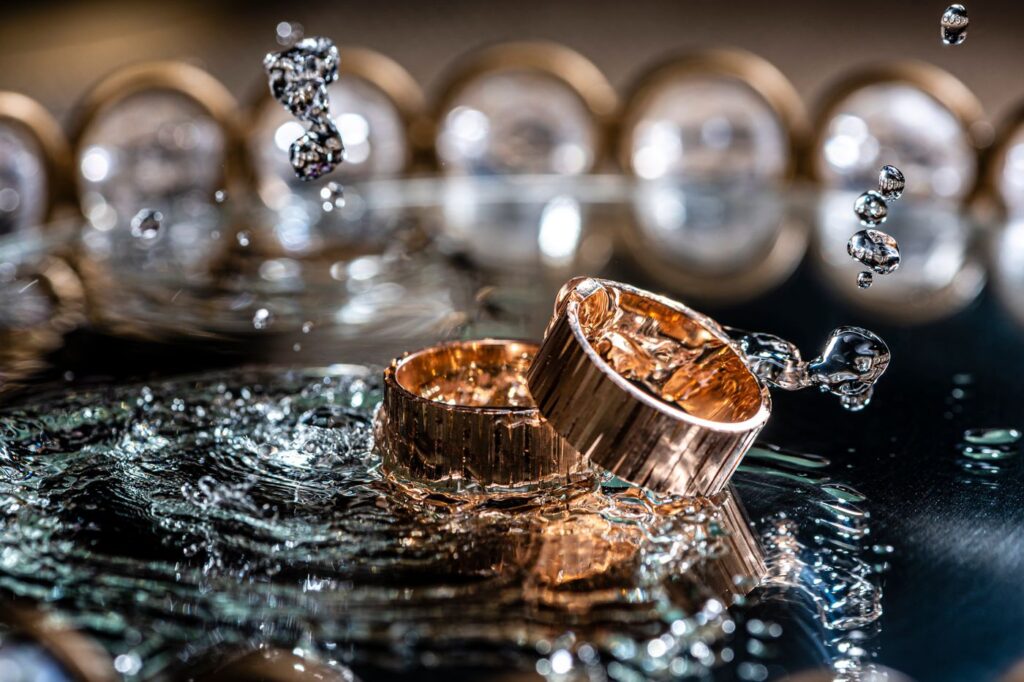
Whether you have inherited a bracelet, found a ring at a flea market or bought a chain online, the question is the same: is it real gold? A few simple checks at home can tell you a lot, and some can rule out a fake in seconds. But no home test is as reliable as a professional one, and a few popular “tricks” can damage your jewellery. Here is how to tell if gold is real, which tests work, and when to see a jeweller.
1. Look for a Hallmark or Karat Stamp
Start with a magnifying glass. Genuine gold jewellery is usually stamped with its purity, often on the inside of a ring band, on a clasp or near the end of a chain. Common marks include:
| Karat mark | Fineness mark | Gold content |
|---|---|---|
| 9K | 375 | 37.5% |
| 10K | 417 | 41.7% |
| 14K | 585 | 58.5% |
| 18K | 750 | 75% |
| 22K | 916 | 91.6% |
| 24K | 999 | 99.9% |
Watch for marks that indicate gold is only on the surface: GP (gold plated), GEP (gold electroplated), HGE (heavy gold electroplate), RGP (rolled gold plate) and GF (gold filled). These pieces contain real gold, but only as a layer over another metal. Our guide to gold vermeil vs gold plated vs gold filled explains the differences.
A stamp is a good sign, not proof. Stamps can be faked, and older or handmade pieces sometimes have none at all.
2. The Magnet Test
Gold is not magnetic. Hold a strong magnet, such as a neodymium magnet, close to the piece. If it jumps to the magnet, the item is most likely plated steel or another base metal. If it does not react, that does not prove it is gold, because many non-magnetic metals, such as copper, brass and aluminium, are used in fakes. Also bear in mind that clasps often contain a steel spring, so test the main body of the piece.
3. Look for Wear and Discolouration
Examine areas that rub against skin or clothing: the edges of a ring, the clasp, the links of a chain. If you see a different metal showing through, often coppery, silvery or greyish, the piece is plated. Solid gold does not flake or peel. A green or black mark on your skin after wearing a piece can also point to base metals, although low-karat gold alloys can occasionally react with skin too.
4. The Density Test
Gold is very dense, which makes this the most scientific test you can do at home, though it works best on pieces without stones. Pure gold has a density of about 19.3 g/cm³, while 18K gold is roughly 15 to 16 and 14K roughly 13 to 14.5, depending on the alloy.
- Weigh the item on a precise digital scale in grams.
- Fill a small container with water, place it on the scale and zero it.
- Suspend the item in the water by a thin thread without touching the sides or bottom. The reading is the weight of displaced water, which in grams equals its volume in cubic centimetres.
- Divide the item’s weight by that volume.
A result far below 13 suggests the piece is not solid gold of a common karat. Small pieces make accurate measurements difficult, so treat borderline results with caution.
5. The Ceramic Scratch Test
Drag the piece gently across the unglazed bottom of a ceramic tile or plate. Real gold leaves a gold-coloured streak, while a black or grey streak suggests another metal. The catch is that this test scratches your jewellery and can wear through plating, so only try it on an inconspicuous spot, and not on anything valuable or sentimental.
Tests to Avoid
- The bite test: pure gold is soft enough to dent, but modern alloys are not, and you can damage both the item and your teeth.
- The vinegar test: the idea is that fake gold changes colour in vinegar. It only catches the crudest fakes and can harm gemstones, pearls and plated items. See what vinegar does and does not clean.
- The float test: gold sinks, but so do almost all metals, so it tells you nothing.
- Home acid kits without training: nitric acid testing kits can be accurate, but they involve corrosive chemicals and scratching the piece. They are best left to people who use them regularly.
When to Go to a Jeweller
If a piece is valuable, sentimental or you plan to sell it, have it tested professionally. Many jewellers and gold buyers use X-ray fluorescence (XRF) analysers, which measure the metal content in seconds without any damage. Electronic gold testers and professional acid tests are also common. A jeweller can tell you not only whether the item is gold but also its karat, which determines its value.
Signs That Gold Is Probably Fake
- It sticks to a magnet.
- Another metal shows through at worn edges.
- The stamp reads GP, GEP, HGE or RGP.
- The price was far below the value of its weight in gold.
- It feels unusually light for its size.
Conclusion
Start with the stamp and the magnet, look closely at wear points and, if you are curious, try a careful density test. Together these give a good indication of whether your gold is real. For certainty, especially before buying or selling, a jeweller’s non-destructive test is quick, inexpensive and far more reliable than any home method.