
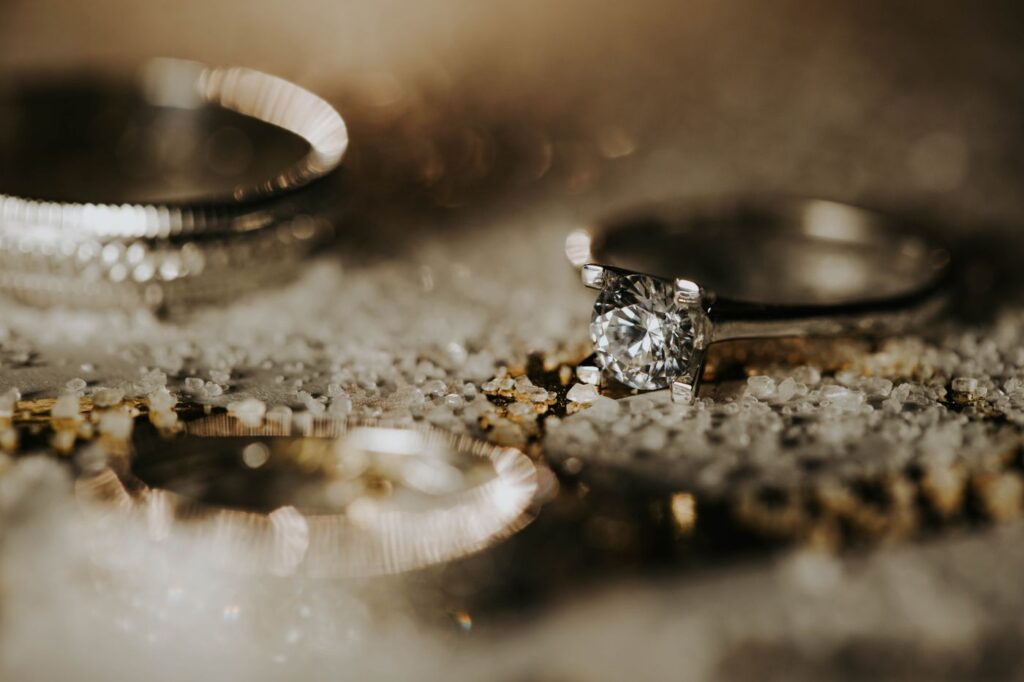
Moissanite has become one of the most popular alternatives to diamond, especially for engagement rings. At a glance the two stones look similar: colourless, brilliant and hard enough for daily wear. But they are different materials with different optical properties, durability and prices. Here is what separates moissanite from diamond, and how to decide which is right for you.
What Is Moissanite?
Moissanite is silicon carbide. It was identified by French chemist Henri Moissan, who found tiny crystals in 1893 in rock samples from Meteor Crater near Canyon Diablo, Arizona. At first he thought they were diamonds. Natural moissanite is extremely rare, found only in minute grains, so every moissanite sold in jewellery is created in a laboratory. Gem-quality lab-grown moissanite entered the jewellery market in 1998, when Charles and Colvard began selling it.
What Is a Diamond?
A diamond is pure carbon crystallised in a very compact structure. Natural diamonds formed deep in the Earth over billions of years, while lab-grown diamonds are made in weeks using high pressure and high temperature or chemical vapour deposition. A lab-grown diamond is chemically and physically the same as a natural one. Moissanite is not a diamond of any kind. For the difference between the two types of diamond, see our guide to lab-grown vs natural diamonds.
Moissanite vs Diamond at a Glance
| Property | Moissanite | Diamond |
|---|---|---|
| Material | Silicon carbide | Carbon |
| Mohs hardness | About 9.25 to 9.5 | 10 |
| Refractive index | About 2.65 and higher | 2.42 |
| Dispersion (fire) | 0.104 | 0.044 |
| Refraction | Doubly refractive | Singly refractive |
| Specific gravity | About 3.22 | About 3.52 |
| Origin | Lab-created | Natural or lab-grown |
Brilliance and Fire
The biggest visible difference is how the stones handle light. Moissanite has a higher refractive index than diamond and more than twice diamond’s dispersion, the property that splits white light into spectral colours. The result is a stone that throws strong rainbow flashes, especially in sunlight. Some people love this “disco ball” effect; others find it looks less like a diamond, whose sparkle is a balance of white brilliance and coloured fire. Larger moissanites show the difference more clearly than small ones.
Moissanite is also doubly refractive. Looking through the top of some stones with a loupe, you can see the back facet edges doubled. Cutters usually orient the stone to minimise this, but it is one of the ways gemmologists tell the two apart.
Durability
Diamond is the hardest natural material, at 10 on the Mohs scale, and resists scratches better than anything else you can wear. Moissanite is close behind, harder than sapphire and ruby at 9, so it is very suitable for everyday rings. Both stones can still chip if struck hard at a vulnerable point, such as a thin girdle or a pointed corner, so protective settings are sensible for active lifestyles.
Colour
Early moissanite often had a yellowish or greenish tint. Modern production has improved dramatically, and most moissanite now sold is described as colourless or near colourless. Some stones can still show a faint tint in certain lighting. Diamonds are graded on the GIA D to Z scale, and colourless diamonds command the highest prices.
Size and Weight
Moissanite is lighter than diamond. A moissanite of the same dimensions weighs roughly 10% less, so moissanite is normally sold by millimetre size or by “diamond equivalent weight” rather than by carat. When comparing, compare the diameter in millimetres, not the carat figure.
Price
Moissanite costs a small fraction of a natural diamond of the same size, and usually well under the price of a lab-grown diamond too. That makes it possible to buy a large, clean-looking centre stone on a modest budget. Prices vary by brand, quality and cut, and premium moissanite brands charge more than generic stones.
Resale Value
Neither moissanite nor lab-grown diamonds hold resale value well. Natural diamonds have an established secondary market, although resale prices are typically well below retail. If future resale matters to you, natural diamond is the only option with meaningful value, but for most people an engagement ring is a keepsake rather than an investment.
Can You Tell Them Apart?
To the naked eye, many people cannot, especially with smaller stones. Clues include the stronger rainbow fire of moissanite and facet doubling under magnification. Moissanite conducts heat almost as well as diamond, so older thermal diamond testers can mistake it for diamond. Jewellers use testers that also measure electrical conductivity, or gemmological instruments, to separate them reliably.
Ethics and Sustainability
Because it is made in a laboratory, moissanite avoids concerns linked to mining. Its environmental footprint depends mainly on the energy used in production, as with lab-grown diamonds. Natural diamond buyers can look for stones with documented origins and responsible sourcing policies.
Which Should You Choose?
- Choose moissanite if you want the biggest, brightest stone for your budget, love strong rainbow sparkle and do not care about resale.
- Choose a lab-grown diamond if you want a real diamond with diamond’s look and hardness at a lower price than natural.
- Choose a natural diamond if rarity, tradition and some residual value matter most to you.
Whatever you choose, keeping the stone clean is what keeps it bright. The methods in our guide on how to clean a diamond ring at home work for moissanite too.